
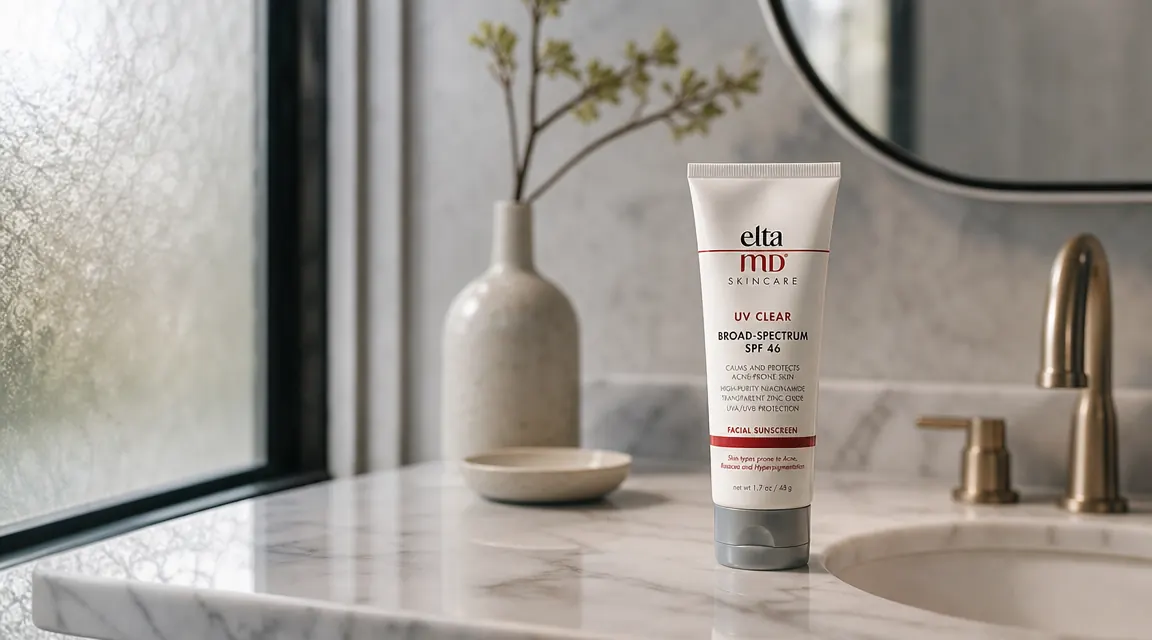
For most of my adult life, sunscreen was the step I skipped. Not because I didn't know better. I knew better. But every SPF I tried either broke me out within a week, left a white cast that sat under my foundation like spackling compound, or felt so greasy by noon that I looked like I'd been deep-fried. My skin is combination, acne-prone, and runs dehydrated underneath a persistently oily T-zone. It is, objectively, a difficult client. So when my dermatologist handed me a sample of EltaMD UV Clear SPF 46 in January 2025 and said 'just try this one,' I took it home and told myself I'd give it two weeks before abandoning it like everything else.
I did not abandon it. A year later, the tube lives on my bathroom counter every single morning, between my niacinamide serum and my lip balm. That's the honest headline. But a year of daily use also teaches you things a two-week test never could, and some of what I learned is less flattering than the marketing copy suggests. This is that accounting.
The Quick Verdict
The most genuinely non-comedogenic SPF I've found for acne-prone combo skin. The niacinamide bonus is real, the texture is legitimately lightweight, and a year of daily use moved the needle on hyperpigmentation in a way I didn't expect. Main drawbacks: the price stings on a 1.7 oz bottle, and reapplication mid-day under makeup is basically impossible without disrupting your face.
Amazon Check Today's Price →Still hunting for a sunscreen your breakout-prone skin will actually tolerate?
EltaMD UV Clear SPF 46 is the one my dermatologist recommended and the one I kept using after a full year. Check the current price and availability below.
Amazon Check Today's Price on Amazon →How I've Used It: A Year of Daily Application
My testing conditions are specific: 37 years old, 128 lbs, combo skin with active hormonal breakouts mostly along my jawline and chin. I was using The Ordinary Niacinamide 10% every morning before SPF, and a prescription azelaic acid at night. No retinoid during most of this period, which I want to disclose because retinoids and SPF have an obvious synergy and I didn't want to muddy the attribution.
I applied EltaMD UV Clear as the final step of my morning routine, roughly a half-teaspoon to my face and neck, every day including in winter. On most days I was not reapplying, which I'll address in the cons section because dermatologists will correctly point out that SPF duration is not all-day coverage. On days I was spending time outdoors, I reapplied with a mineral SPF powder over my foundation. The UV Clear itself was my base-layer daily driver, seven days a week, 365 days.
I did not take formal before-and-after photos with calibrated lighting, so I'll caveat this entire review with that limitation. What I do have is my own skin memory, the acne log I kept for breakout pattern tracking, and the honest acknowledgment that a year of consistent SPF use on sun-exposed skin is going to show results regardless of the formula, because UV-induced melanogenesis is just physics. I'm less interested in whether EltaMD UV Clear is better than wearing nothing, and more interested in whether it's better than the other SPFs I tried in the years before.
What the Ingredient List Actually Says
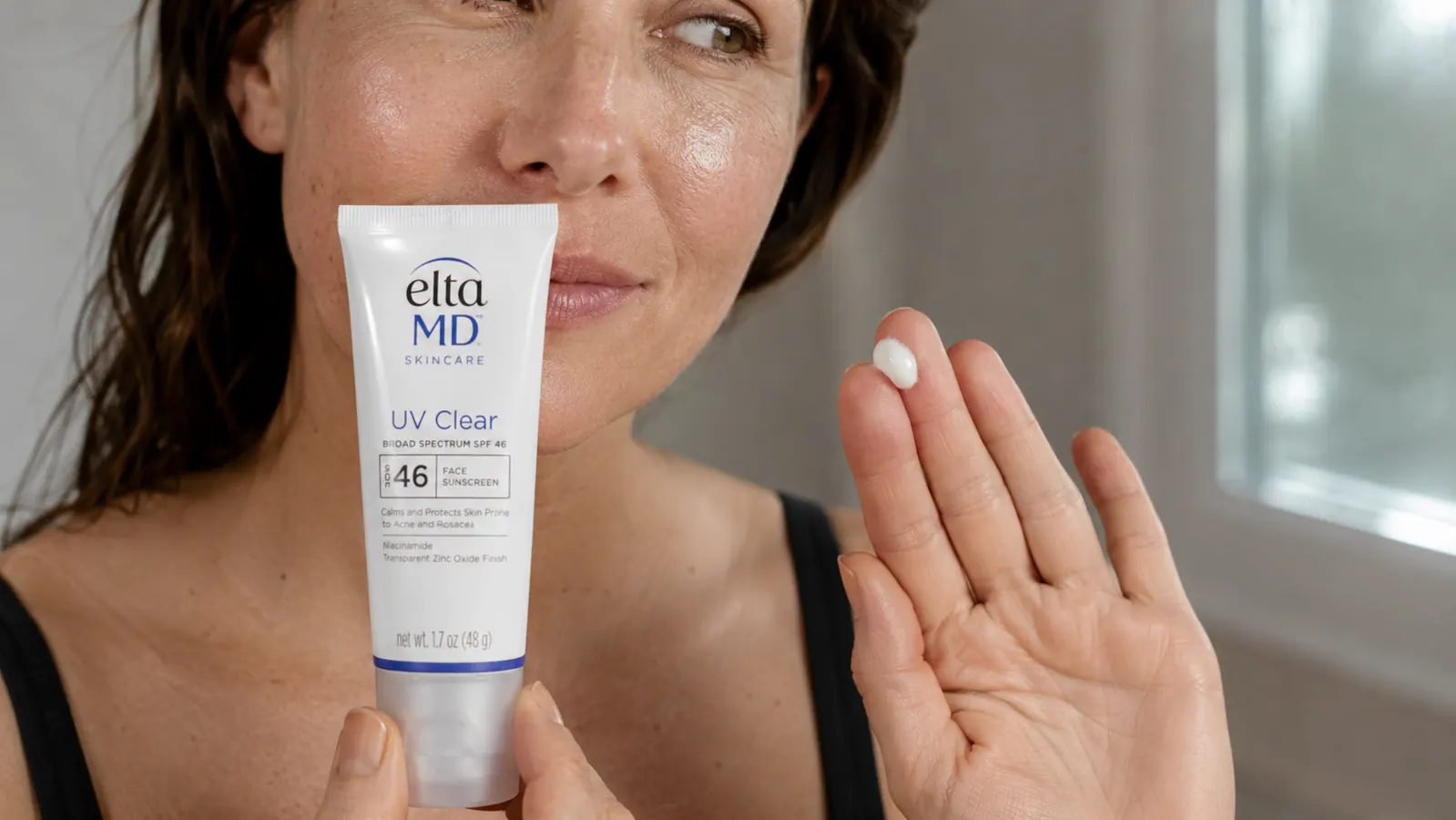
EltaMD UV Clear SPF 46 uses 9.0% zinc oxide as its sole active ingredient. That makes it a true mineral sunscreen, meaning the UV protection works via physical reflection rather than chemical absorption and conversion. For people with sensitized or breakout-prone skin, this distinction matters. Common chemical filters like oxybenzone, avobenzone, and octinoxate are known irritants for a subset of people, and some research links certain filters to comedogenicity. Zinc oxide has a long safety record and doesn't penetrate the skin barrier the way chemical filters do.
The inactive ingredient I care about most here is niacinamide, which appears about midway down the list. Niacinamide at concentrations of 4-5% has solid peer-reviewed evidence behind it for reducing sebum production, fading post-inflammatory hyperpigmentation, and improving skin texture. EltaMD doesn't publish the concentration in UV Clear, but the placement in the ingredient list suggests it's functional rather than cosmetic. The formula is also fragrance-free, oil-free, and does not contain parabens or chemical sunscreen filters. For a breakout-prone person, that's a genuinely clean profile.
The texture formula uses a silicone base, specifically cyclopentasiloxane, which is what gives it that almost-weightless fluid feel. Worth noting for anyone who avoids silicones generally: they're on the list. Most people with acne-prone skin tolerate cyclopentasiloxane without issue, but if silicones have historically broken you out, this is not the SPF for you.
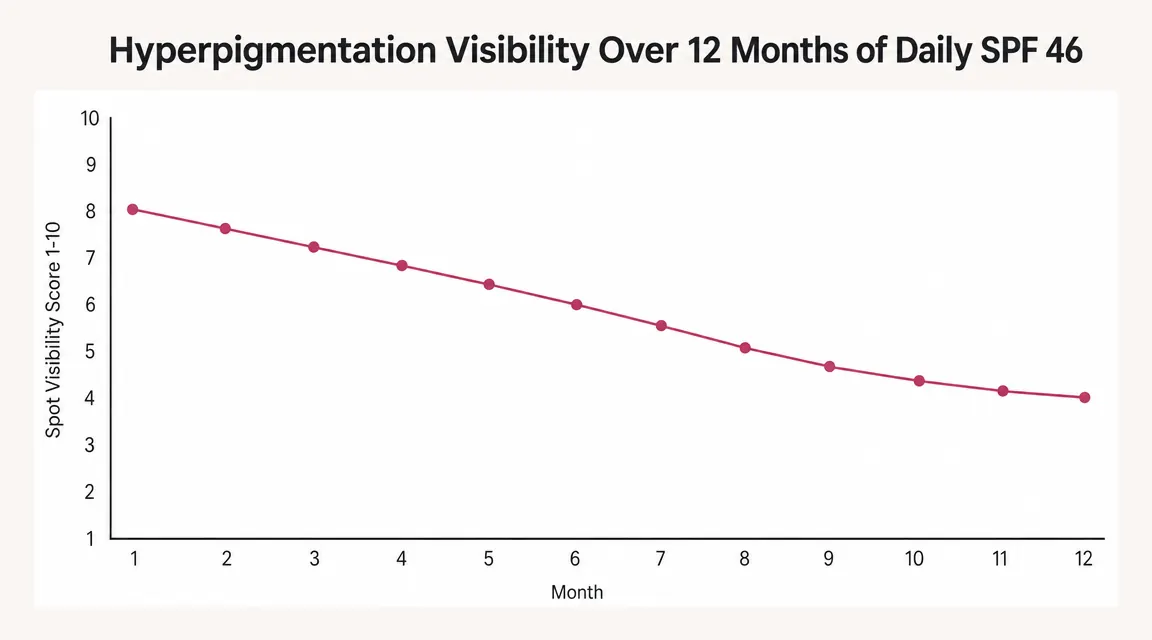
After six months of daily use, the post-breakout dark spots on my left jawline faded enough that I stopped trying to cover them with concealer. I'm not attributing all of that to EltaMD. But consistent SPF plus the niacinamide in the formula probably both contributed.
Long-Term Results: What a Year of Data Actually Shows
The most significant change I noticed over 12 months was in my hyperpigmentation. I get post-inflammatory dark spots after breakouts, mostly concentrated on my left jawline (I sleep on my right side; left side stays warmer, breaks out more). By month six, spots from breakouts that happened in February and March had faded to something close to my natural skin tone. That timeline is faster than I'd seen before this routine, and the most plausible explanation is that consistent daily UV blocking interrupted the melanogenesis cycle that keeps those spots dark. Sun exposure re-stimulates melanin in those damaged cells. SPF breaks the cycle.
My overall skin tone became more even. By 'more even' I mean less of the mottled, patchy redness that I'd normalized as just what my skin does. A chunk of that redness is UV-induced vasodilation and surface inflammation. Block the UV consistently, and some of it calms down. It's not dramatic. I didn't end up with porcelain skin. But side-by-side comparison of January 2025 and January 2026 shows real change in uniformity.
Breakout frequency: honestly flat. I did not break out more, which on a new product is itself a win. I did not break out less, which means I can't attribute any acne reduction to EltaMD specifically. My hormonal jawline breakouts continued on roughly the same monthly cycle. What I can say is that after a year, I have no evidence that EltaMD UV Clear is contributing to my breakouts, which for a daily-use SPF is a higher bar than it sounds.
Texture and Wear Under Makeup
The texture is the easiest yes in this review. It applies like a lightweight serum, not a cream. A small amount covers my face and neck without pilling, without balling up under foundation, and without leaving a white cast. My skin tone is medium, and I get zero visible cast. Fairer skin tones have reported a faint white cast in some lighting, though this is much less pronounced than older mineral SPFs that used uncoated zinc oxide particles.
Under my everyday makeup routine, which is minimal, UV Clear behaves well. It doesn't pill under a tinted SPF moisturizer layered on top. It doesn't destabilize my setting powder. On days when I skip everything else and just apply UV Clear plus a tinted lip balm, my skin looks genuinely good in a way that used to require more work. Some of that is probably the cumulative effect of a year of SPF use improving my baseline skin quality. But the formula's finish, which is a natural matte-to-satin, contributes.
One honest wear note: by hour six on a humid day, I look oily. This is partly my skin type and partly the fact that I am not reapplying SPF the way I should be. The original formula does not disappear into my skin without trace; it does contribute a baseline of slip that, combined with active sebum production, starts to show by late afternoon. If you are drier than I am, this will likely be a non-issue.

The Reapplication Problem
This is the structural limitation of EltaMD UV Clear that no reviewer talks about enough. Dermatologists recommend reapplying SPF every two hours of UV exposure. UV Clear is a liquid formula designed for a clean face. Reapplying it over a full face of makeup at 2pm means either washing your face and starting over, patting it gingerly over your makeup hoping it doesn't streak, or using a mineral SPF powder for your midday reapplication. That third option is what I do, but it means UV Clear is doing heavy lifting only for the first two hours of your morning, and after that you're relying on a powder reapplication with different coverage geometry.
I don't hold this against EltaMD specifically. It's a limitation of any liquid SPF and the makeup-wearing lifestyle. But if your dermatologist is telling you that UV Clear will protect you all day, they're glossing over the reapplication math. The formula is excellent as a morning base layer. Beyond that, you need a reapplication strategy, and UV Clear doesn't solve that problem for you.
Alternatives I Tried Before Landing Here
In the three years before switching to EltaMD, I tried eight different sunscreens with varying levels of suffering. Two chemical SPFs caused breakouts within two weeks: one Korean formula with high alcohol content, and one US brand with fragrance I didn't catch on first read. A popular mineral SPF in the $12-15 range left a white cast visible in fluorescent light. A tinted SPF moisturizer from a prestige brand was beautiful for two weeks, then started pilling under my concealer for reasons I never figured out. The SPF I used longest before EltaMD was a Japanese uv-milk style formula that absorbed beautifully but smelled faintly clinical and was annoying to import consistently.
EltaMD UV Clear wins that comparison not on any single dimension but on the combination of: no breakouts after sustained use, no white cast on medium skin, no fragrance, texture that behaves under makeup, and a dermatologist reputation that at least signals the formula was developed with skin compatibility as a real priority rather than an afterthought.
What I Liked
- 9% zinc oxide-only UV filter: no chemical sunscreen actives, which lowers irritation and sensitivity risk significantly
- Legitimately non-comedogenic after 12 months of daily use on acne-prone skin with no new breakouts attributable to the formula
- Fragrance-free, paraben-free, oil-free: clean profile for sensitive and reactive skin types
- Niacinamide in the inactive ingredients contributes to sebum regulation and PIH fading over time
- No white cast on medium skin tones; natural satin finish plays well under foundation and tinted moisturizer
- Lightweight fluid texture that doesn't pill, ball up, or destabilize makeup layers above it
Where It Falls Short
- 1.7 oz bottle at current pricing works out to a high cost-per-use for daily face plus neck application
- Contains cyclopentasiloxane (a silicone); not a problem for most acne-prone skin but worth noting for silicone-sensitive users
- Liquid formula is not designed for reapplication over makeup; you need a separate mid-day SPF strategy
- Some users with lighter skin tones report a faint white cast in certain lighting conditions
- Niacinamide concentration is not disclosed; functional but not a replacement for a dedicated niacinamide serum at 10%
Who This Is For
EltaMD UV Clear is built for the person whose skin breaks out from everything, who has already bought and returned several SPFs in frustration, and who is willing to spend more per ounce on a formula they can actually wear every day without consequences. It's excellent for acne-prone skin, post-procedure or sensitized skin, anyone managing hyperpigmentation who wants the SPF to also deliver low-dose niacinamide, and anyone whose skin has historically reacted to fragrance or chemical sunscreen filters. Dermatologists and estheticians recommend it constantly, and after a year of daily use, I understand why.
Who Should Skip It
Skip EltaMD UV Clear if you need a heavy-duty waterproof SPF for outdoor activities, a formula designed to be reapplied over makeup easily, or a budget-friendly everyday option. If you have a fair complexion and are sensitive to even subtle white cast, test carefully before committing. If you avoid silicones in your skincare, check the full ingredient list first. And if your skin is reliably non-reactive and you've never had an issue with mainstream sunscreen formulas, there are cheaper options in the same performance tier that may serve you just as well.
If breakouts from sunscreen are the reason you've been skipping SPF, this is the formula worth trying.
EltaMD UV Clear SPF 46 has stayed on my bathroom counter for a full year. The niacinamide helps, the zinc-only filter doesn't clog, and the texture actually behaves under makeup. See today's price and availability on Amazon.
Amazon Check Today's Price on Amazon →